

VALDR · Core · Rev. 1
VALDR
Order and Precision
Twenty-four positions. One ring. Decide later.
Modular Storage Tin · Stainless Steel 1.4301
First run in preparation. Nothing is for sale yet.
Engineered
to the Millimetre
Made from stainless steel 1.4301. Wall thickness 1,1 mm. Lid and base are two parts. The seam sits just above half height and is deliberately visible.
Modular divider system with 24 positions on a 15° grid. Carrier ring centred in the base. Engraving 0,12 mm deep.
Each divider drops into a detent and stays there. Nothing threads, nothing clamps, nothing needs a tool.
Why There Is a Ring
A tin is easy. Dividers that stay where you put them are not.
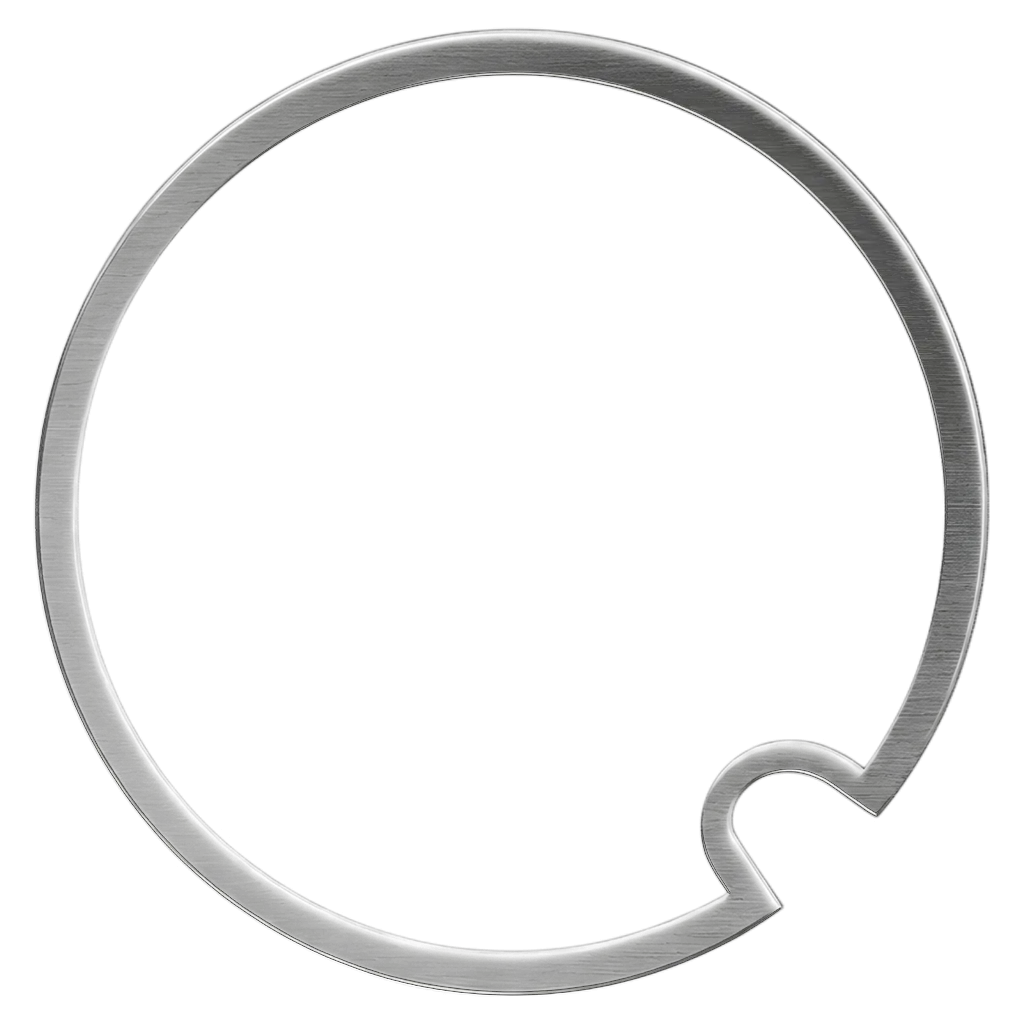
The carrier ring is the answer. It sits centred in the base and carries twenty-four detents on a fifteen degree grid. A divider drops into a detent and stops there. Move it, and it stops at the next one.
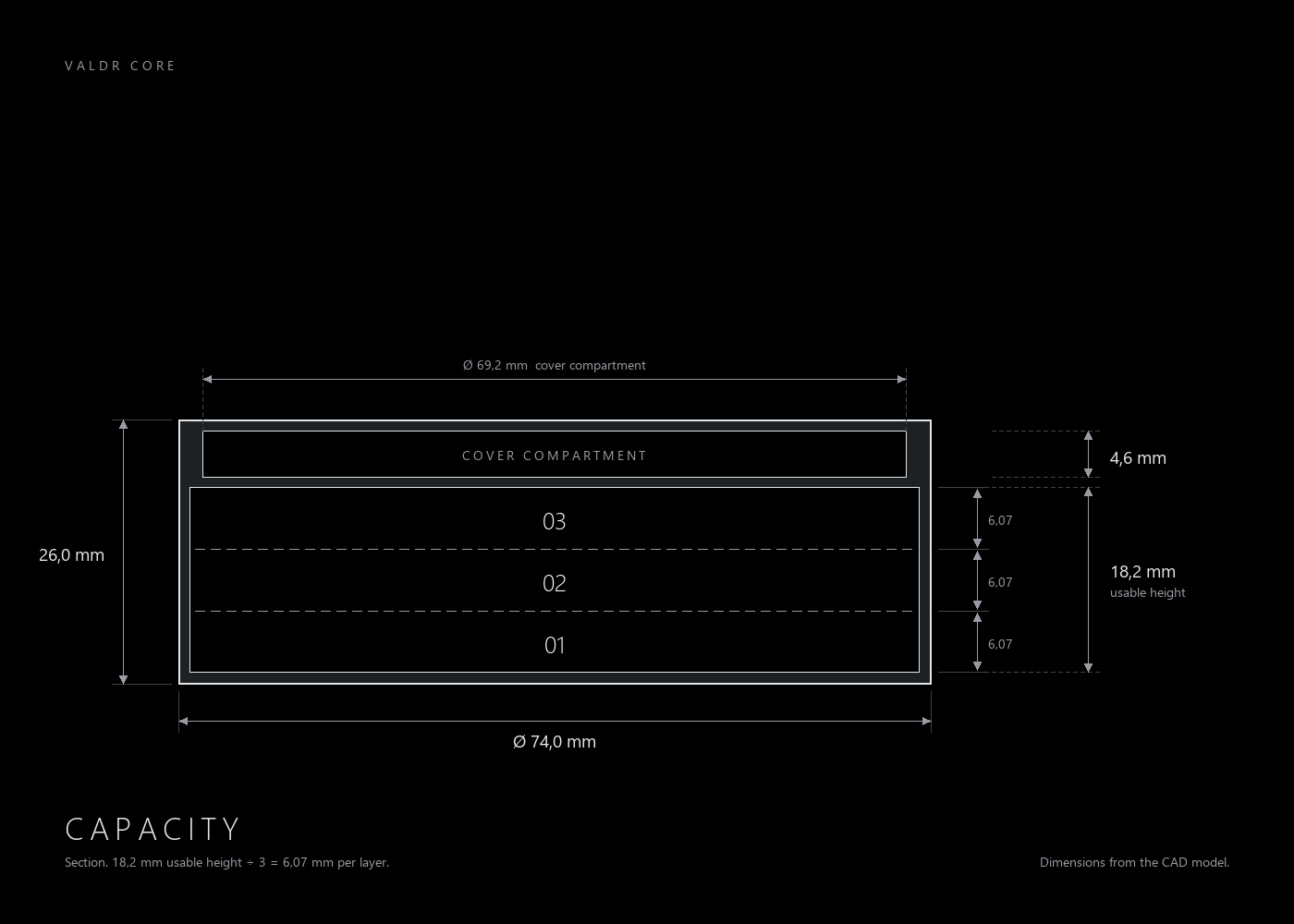
Everything else on this object follows from that decision. The wall thickness, the usable height of 18,2 mm, the finger notch at the rim. The dividers set the task. The ring solved it.
Field Note 01 / 13
The layer that protects this tin is two nanometres thick.
1.4301 does not resist corrosion because it is dense. It resists because the chromium in it reacts with oxygen and forms a film of chromium oxide between one and five nanometres thick — thousands of times thinner than a sheet of paper. Scratch through it and it reforms within seconds, as long as there is air. The steel repairs its own surface. The brushed finish is bare steel.
Every contour comes from the CAD model. The drawing is the basis, not the illustration.
Dimensions &
Materials
All dimensions in millimetres.
Mating surfaces ±0,05 mm.
All other dimensions to ISO 2768-m.
Material EN 1.4301 / AISI 304.
Top View
Finger notch at the lid edge, 8,3 mm wide.
Side View
Overall height 26,0 mm. Seam between lid and base clearly visible.
Finger Notch
8,3 mm wide — visible from above and from the side. For lifting the lid.
Open — 3 Compartments
Carrier ring Ø 69,0 mm · 24 detents on a 15° grid. Three divider modules installed, repositionable in 15° steps.
Carrier Ring
The whole idea. 24 detents on a 15° grid. A divider sits where you put it and nowhere else.
Lid Lifted
Lid and base are two parts. The seam sits just above half height.
Exploded View
Five parts in assembly order: lid, cover disc, carrier ring, divider module, base.
Field Note 02 / 13
1.4301 is not a name. It is an address.
Under EN 10027-2 every European steel carries a number. The leading 1 means steel. The 43 places it among the chromium-nickel stainless grades. The 01 identifies this exact composition. AISI 304 is the American name for the same material. We print the number rather than a word like "premium steel", because a number can be checked and a word cannot.
Material
1.4301
AISI 304
VALDR Core
Brushed stainless steel. Three compartments as standard.
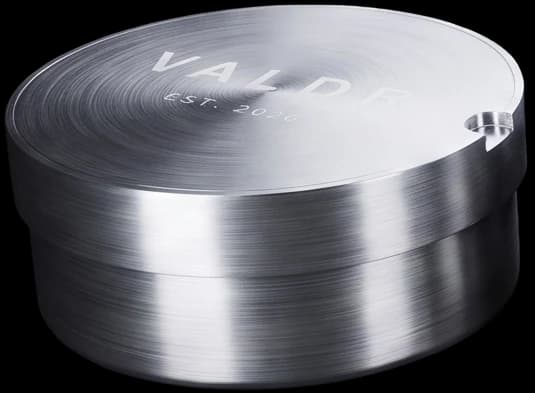
 Brushed Stainless
 Graphite
 Matte Black
 Midnight Blue
 Champagne
Five finishes. Brushed stainless steel, graphite, matte black, midnight blue, champagne. Same geometry, same carrier ring.
Your Choice
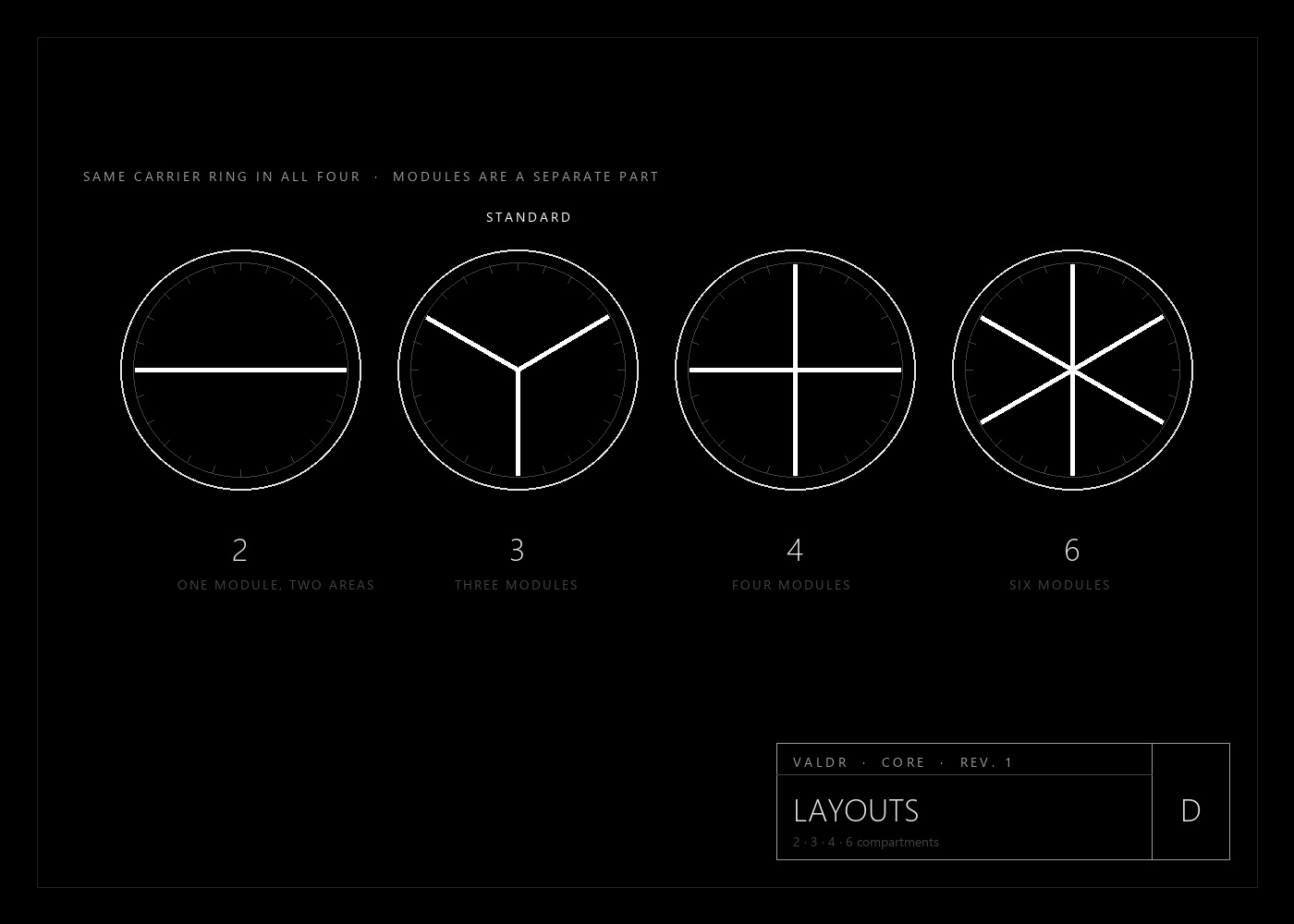
3 compartments is the standard layout. All variants — 2, 3, 4 and 6 compartments — use the same carrier ring. Divider modules can be swapped or removed at any time. Divider modules are a separate part, so a layout is never final.
2 Compartments
Two modules, opposite each other. Repositionable in 15° steps.
3 Compartments — Standard
The standard layout. Three modules, evenly distributed.
4 Compartments
Four sectors. Four divider pieces, held by the carrier ring.
6 Compartments
Maximum layout. Six equal sectors, maximum order.
Field Note 03 / 13
Why 304 and not 316.
316 adds two to three percent molybdenum, which buys resistance to chlorides: sea water, coastal air, road salt. For an object carried in a pocket it buys nothing but cost. 304 is the grade used for cutlery, sinks and food equipment. We chose the one that matches the job.
Three Booklets
Three booklets, twenty pages each. One on where the object came from, one on exactly where it stands today, one on how far an object like this could be pushed before it stops being good.
How an object comes to exist when nothing on the market is good enough.
Twenty Pages · PDF · Champagne
Everything here is provisional, and dated on purpose.
Twenty Pages · PDF · Brushed Stainless
How far can an object like this go before it stops being good?
Twenty Pages · PDF · Midnight Blue
Not yet available. They will be offered when the shop opens.
What Is Coming
PROOF
The first run of VALDR CORE. Finishes not yet fixed.
Status: In preparation
FOLIO
The booklets. PROVENANCE stays as it is. INTERIM is rewritten as the project moves. CONJECTURE grows.
Status: Three written
First Run
The Core.
In preparation.
Wordmark engraved 0,12 mm deep. Will ship from Germany.
Before You Ask
Yes, and that reaction protects it. Steel 1.4301 contains about eighteen percent chromium. In air, the chromium forms a layer of chromium oxide a few nanometres thick. It builds itself, needs no treatment, and forms again wherever the surface is opened.
On bare steel, the oxide layer closes again by itself, because fresh chromium meets oxygen in the scratch. What remains is a visible mark, not an open spot. A brushed surface hides fine marks better than a polished one. On the coloured finishes, a deep scratch can show the steel underneath.
Take the dividers out. Warm water, a drop of mild washing-up liquid, a soft cloth along the grain, then dry it. No steel wool and no scouring powder, they cut the surface. No bleach and no chlorine cleaners: chlorides attack the oxide layer.
Yes. Every divider is a separate part. It drops into a detent on the carrier ring and stays there. No thread, no clamp, no tool. Take one out, move it by fifteen degrees, or leave all of them out.
Twenty-four divides evenly by two, three, four and six, so each of these layouts gives equal compartments on the same ring. With a detent every fifteen degrees, you can also make one compartment larger than the rest.
What This List Does Not Cover
Ask directly. The answer comes from the person who designed the object.
VALDR · Core · Rev. 1 · 2026 — Material 1.4301 / AISI 304 · All dimensions in mm · Mating surfaces ±0,05 mm · Engraving 0,12 mm deep